

Every agency relies on website contact forms to capture leads, support requests, and inquiries. Yet many agencies still depend on default server mail methods like PHP mail or hosting-based email sending. This often leads to missing emails, spam issues, and frustrated clients. SMTP solves these problems.
It provides authenticated, secure, and predictable email delivery. In this article, you will see why SMTP should be the standard for every agency and how it helps protect leads, improve operations, and boost client satisfaction.
The Problem With Traditional Website Email Sending
Most websites send form submissions using basic server mail functions. They may use PHP mail, a hosting provider’s default mail, or a simple built-in script. On the surface, this seems convenient. But it creates major reliability and deliverability issues.

Emails Often End Up in Spam
Default mail functions do not authenticate emails properly. As a result, email providers like Gmail, Outlook, and Yahoo often mark these messages as suspicious.
When an email lacks authentication, inbox filters assume it could be spoofed or forged. Therefore, many legitimate messages sent from contact forms are filtered into the spam folder or rejected completely.
Shared Hosting Makes Things Worse
Many agency clients host their websites on shared servers. These servers share IP addresses among hundreds of websites. If even one website sends spam, the IP reputation for the entire server drops.
This affects all outgoing emails, including messages sent through the contact form. Therefore, your clients can miss valuable leads without even knowing it.
Missed Leads Hurt Business
Every missed form submission could be a lost sale. This is especially painful for service businesses, e-commerce websites, and local companies that depend heavily on inquiries.
Agencies often face blame when clients do not receive emails. Even though the agency did nothing wrong, the default mail method creates problems that reflect poorly on the agency’s reliability.
Agencies Spend Time Troubleshooting
When contact form emails fail, agencies face extra support work. They must investigate server logs, test forms, contact hosting support, and reassure clients. This drains time and resources. Moreover, it also creates friction between the agency and the client.
Choose the Right SMTP Setup for Your Agency
Get expert support & streamline your email delivery process with confidence.
How SMTP Solves These Problems?
SMTP, also known as Simple Mail Transfer Protocol, is the industry standard for sending authenticated emails. It improves deliverability, adds security, and ensures messages reach the inbox.
SMTP Uses Authentication: SMTP uses credentials such as a username, password, API key, and domain authentication records. This proves to email providers that the message is legitimate and comes from a trusted source. As a result, inbox placement improves dramatically.
SMTP Works With SPF, DKIM, and DMARC: When your agency uses SMTP, it can align sending practices with modern email requirements. These authentication records offer multiple layers of trust.
- SPF reveals which servers are authorized to send mail for your domain.
- DKIM attaches a digital signature that verifies message integrity.
- DMARC helps email providers enforce sending rules and reduce spoofing.
When these records are configured correctly, deliverability becomes more reliable and more consistent.
SMTP Offers Better Control: Using SMTP gives your agency control over sender identity, sending domains, email routing, failed delivery logs, spam filtering, and tracking.
Because SMTP services log every sent message, it becomes easy to diagnose problems or prove whether emails were successfully delivered.
SMTP Improves Branding: Clients want consistency. SMTP allows agencies to send emails using proper domain-based addresses such as info@clientdomain.com. This builds trust and reinforces brand identity. It also ensures that all messages comply with modern email standards.
Read: WordPress Support Services Offering
Operational Benefits of SMTP for Agencies
Implementing SMTP improves more than email delivery. It enhances your agency workflow, reduces support issues, and increases client confidence.
Fewer Support Tickets: When agency websites use SMTP, contact forms function properly. Messages arrive on time and land in the inbox. As a result, clients submit fewer complaints, such as:
- “I’m not getting form submissions.”
- “My contact form has stopped working.”
- “Emails were going to spam.”
Because issues decrease, your agency saves time on support work. This allows you to focus on higher-value tasks.
Faster Client Onboarding: SMTP configuration creates a standardized workflow. Agencies can:
- Ask for only the required email credentials
- Set up authentication in a predictable way
- Document the process for internal teams
- Maintain consistency across all client projects
- This speeds up onboarding and reduces uncertainty.
Better Client Relationships: Your clients depend on their websites to generate leads. When leads disappear, trust erodes quickly. Using SMTP maintains reliability. It demonstrates that your agency prioritizes email deliverability. Over time, clients view your agency as more professional, more proactive, and more dependable.
Easy Scaling Across Multiple Websites: As agencies grow, they manage more websites and contact forms. A standardized SMTP implementation ensures consistent behavior, predictable deliverability, improved tracking, and simplified maintenance.
This becomes especially important for agencies managing dozens or hundreds of client sites.
Check out: How Can WordPress White-Label Services Help Scale Agencies
Security Advantages of Using SMTP for Contact Forms
SMTP strengthens email delivery, but it also plays a key role in protecting your clients’ domains and your agency’s reputation. It adds essential layers of authentication and security that prevent misuse, reduce vulnerabilities, and keep communication trustworthy.
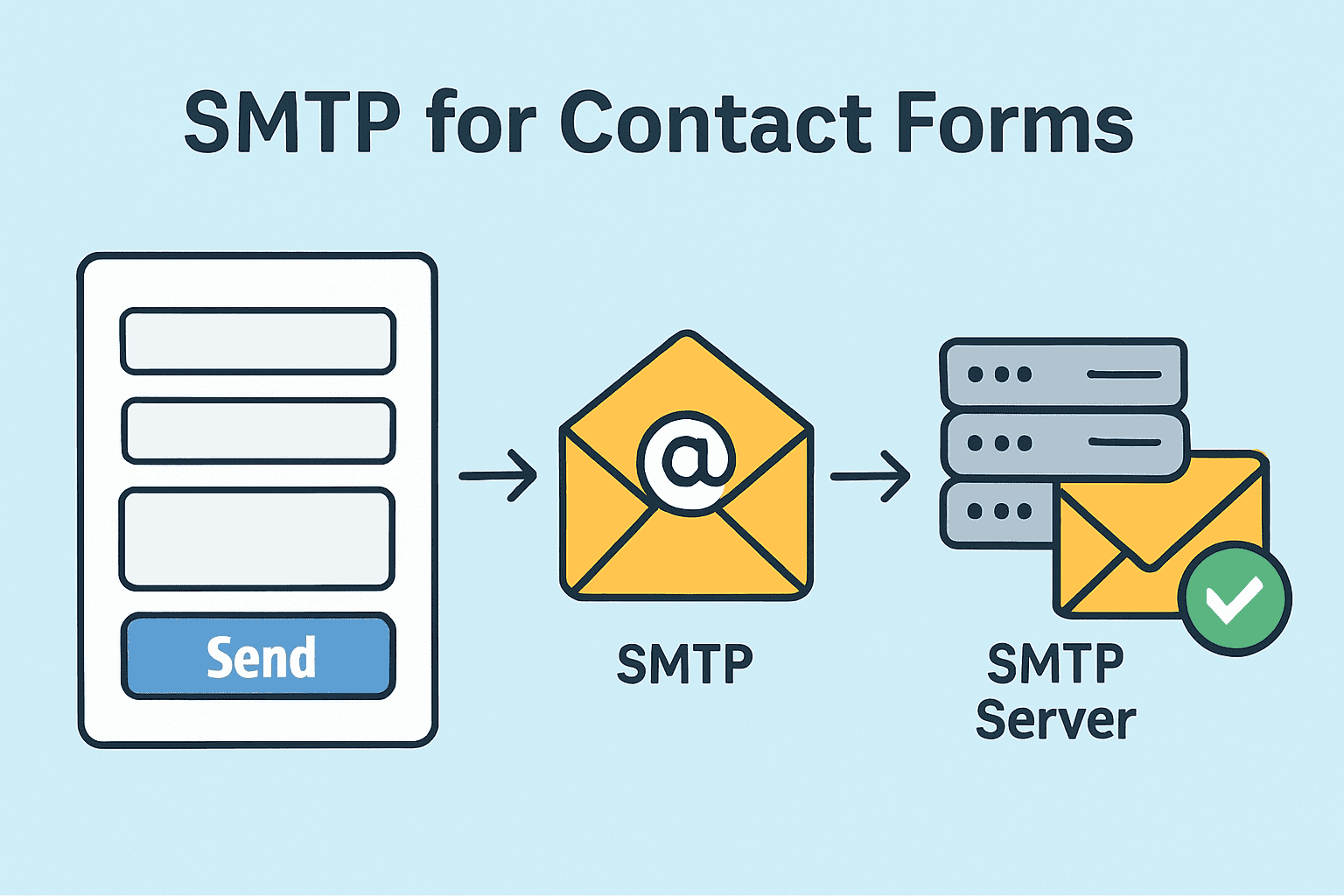
Here’s how SMTP enhances security across multiple fronts.
- Reduces Email Spoofing: SMTP works with SPF, DKIM, and DMARC to verify outgoing messages. These authentication layers make it difficult for attackers to send emails that appear to come from your client’s domain. As a result, spoofing attempts drop, and brand trust remains intact.
- Complies With Modern Email Standards: Email providers continue to tighten their rules. In fact, platforms like Google and Yahoo now enforce stronger authentication for business and bulk senders. SMTP helps agencies meet these standards effortlessly, ensuring that emails are accepted rather than rejected.
- Protects Agency Reputation: Unauthenticated emails can damage a domain’s standing. When a few sites send unverified messages, inbox providers may throttle or block them. By using SMTP, agencies avoid blacklisting issues and maintain a clean sending reputation.
- Secure API and Encryption Options: Most SMTP services support TLS encryption and secure API-based sending. These features protect messages during transmission and reduce the risk of interception. Consequently, email communication stays safe and reliable.
Learn More: Top WordPress Website Maintenance and Care Plan Providers
Top SMTP Providers Agencies Should Consider
Agencies require reliable and scalable SMTP services to deliver enhanced email services to their clients. Below are some top choices that offer strong deliverability and a range of features.
- Mailgun provides excellent analytics, tracking, and deliverability tools. It suits agencies that want detailed logging and strong performance. It also offers flexible pricing and supports API and SMTP sending.
- SendGrid is widely used and provides a feature-rich dashboard. It also integrates easily with most CMS platforms. It offers strong authentication tools and has a reliable reputation.
- Amazon SES is highly cost-effective. It offers strong deliverability but requires some technical setup. It suits agencies with development experience or those managing high-volume email projects.
- Postmark focuses heavily on transactional email. It is known for excellent speed and inbox placement. Agencies often choose it for its reliability and clean interface.
- Brevo (formerly Sendinblue) offers an easy setup and includes a range of marketing tools. It is beginner-friendly and integrates well with CMS platforms.
Choosing the Right SMTP Provider
Selecting the right SMTP provider is an important decision for any agency. After all, the service you choose will influence deliverability, security, and long-term reliability. While many providers offer similar features, the best option ultimately depends on your agency’s priorities. Here are the key factors to evaluate before making a choice.
- Cost: Pricing varies widely among SMTP services. Some offer pay-as-you-go models, while others use monthly plans. Therefore, agencies should compare costs based on client volume and email frequency to avoid overspending.
- Ease of Integration: Smooth integration saves time and reduces setup issues. Providers with simple dashboards, clear documentation, and CMS-friendly plugins make onboarding much faster for agency teams.
- Logging Features: Detailed logs are essential for troubleshooting. Providers that offer delivery reports, bounce tracking, and error insights make it easier to resolve issues and maintain accountability.
- Scalability: As your agency grows, so will your email needs. Therefore, the provider should be able to support higher sending volumes without performance issues or delays.
- Customer Support: Reliable support ensures quick resolution when problems arise. Agencies benefit from providers that offer responsive live chat, ticketing, or phone assistance.
- Compliance Requirements: Finally, agencies must ensure the provider meets authentication, security, and regulatory standards. This includes SPF, DKIM, DMARC, TLS encryption, and data-privacy compliance.
Know More: Is WordPress Consultation Right for You
Tools and Plugins for Easy SMTP Implementation
SMTP integration varies across platforms, but the good news is that many tools simplify the entire process. With the right plugins and services, agencies can quickly and consistently configure authenticated email sending. Below is a breakdown of the most common platforms and the tools that support them.
- WordPress offers several reliable SMTP plugins. Tools like WP Mail SMTP, FluentSMTP, Post SMTP, and Easy WP SMTP make configuration simple. Moreover, they allow agencies to manage credentials, add failover options, and monitor email delivery with ease.
- Webflow does not provide native SMTP support. However, agencies can still route form submissions through authenticated senders using Make, Zapier, n8n, or custom SMTP relays. These automations ensure Webflow forms send messages reliably and securely.
- Shopify handles email sending internally, but agencies can extend functionality with third-party apps. Integrations with services such as Klaviyo or Postmark enable transactional email routing through SMTP for more control and improved deliverability.
- Custom-built sites allow even greater flexibility. Developers can integrate SMTP using tools such as PHPMailer, NodeMailer, Python’s smtplib, Laravel Mail, or Rails’ ActionMailer. Since most frameworks support SMTP by default, implementing secure email sending becomes straightforward.
Best Practices for Agencies Using SMTP
Using SMTP delivers better reliability, but agencies must adhere to specific best practices to fully benefit from it. When these practices are applied consistently, email deliverability improves, troubleshooting becomes easier, and clients receive a smoother experience. Here are the essential guidelines every agency should follow.
Use Domain-Based Emails
Agencies should send form notifications from domain-based addresses such as contact@domain.com or info@domain.com. These addresses look more professional and build trust. Moreover, they improve deliverability because inbox providers prefer messages sent from authenticated domains.
Configure SPF, DKIM, and DMARC
Every client domain needs proper SPF, DKIM, and DMARC records. These authentication layers verify the sender, protect the domain, and ensure consistent inbox placement. When they are configured correctly, email communication becomes more secure and far more reliable.
Avoid Using Personal Email Addresses
Personal email addresses, including Gmail or Yahoo accounts, often fail authentication checks. They lack domain-level control and can easily get flagged as suspicious. Therefore, agencies should always use domain-specific addresses for all contact form emails.
Enable Logging and Email Monitoring
SMTP logs provide valuable insights. They track delivery status, failures, spam rejections, and even IP reputation issues. With this data, agencies can quickly diagnose issues and confirm whether messages were successfully sent and accepted.
Use Failover SMTP When Needed
Some agencies maintain a backup SMTP provider. If the primary service experiences downtime, the failover automatically takes over. This prevents delays, protects lead flow, and ensures uninterrupted message delivery.
Test Forms Regularly
Regular testing is essential, even when everything appears to be working properly. Testing ensures that credentials remain active, authentication is aligned, and messages are consistently delivered to the inbox. It also helps identify spam filter changes early. Consequently, routine testing reduces risks and protects client trust.
Summary
Every agency should use SMTP for handling client contact form submissions. It improves deliverability, strengthens security, reduces support issues, and protects leads.
While default mail functions may seem easier, they create long-term problems. SMTP offers consistency, authentication, and reliability.
By adopting SMTP as a standard practice, agencies can deliver better results, improve client trust, and operate with greater efficiency.
FAQs About SMTP for Contact Forms
Why should agencies use SMTP for contact forms?
Agencies should use SMTP because it authenticates emails, reduces spam issues, and ensures form submissions reach the inbox consistently.
Does SMTP improve deliverability?
Yes, SMTP significantly improves deliverability by using verified sending methods and aligning with SPF, DKIM, and DMARC standards.
Can shared hosting affect email delivery?
Shared hosting can impact delivery because many sites share the same IP address, and a poor IP reputation can cause messages to be flagged as spam.
Is SMTP difficult to set up?
Setting up SMTP is not difficult, especially with the help of plugins, dashboards, and step-by-step authentication guides that simplify the process.
Do all websites need SMTP?
All websites that rely on contact forms or transactional emails should use SMTP to avoid missed leads and ensure reliable communication.
Which SMTP provider is best for agencies?
The best provider depends on your specific needs, but services like Mailgun, SendGrid, Postmark, and Amazon SES offer strong deliverability and a range of features.
What happens if SMTP stops working?
If SMTP stops working, emails may fail to send. Therefore, agencies should enable logging and consider using a backup SMTP provider for continuity.


